Spider control.
Target the spider, not just the web.
From Redbacks in the letterbox to huntsman in the hallway, spiders are a year-round Brisbane problem. Pest-Nett treats webs and harbourages, barriers your perimeter, and reduces the insects spiders feed on — so they stop coming back.
Redbacks near the kids’ play area? Redbacks build in dry, undisturbed spots — under outdoor furniture, around play equipment and in letterboxes. Their bite is painful and requires medical attention. Tell us where the kids play and we’ll prioritise it.
Call 07 3206 6721Common spiders in Brisbane.
Brisbane has hundreds of spider species. Most are harmless and beneficial. A few — particularly the Redback — need professional treatment. Knowing which is which matters.
Know your spider.
- Redback — venomous, dry sheltered webs
- Huntsman — large, hairy, beneficial but alarming
- White-tailed — wandering, indoor corners
- Wolf Spider — ground hunter, hairy brown
- Orb-weaving — garden webs, harmless
The spiders Pest-Nett treats.
Not every spider needs treatment — orb-weavers and huntsman are beneficial. We focus on the dangerous and the distressing, and tell you the difference.
Redback Spider
Latrodectus hasselti
Female is glossy black with a red-orange stripe on the upper abdomen and a red hourglass underneath. Body about 10mm; legs slender. Builds messy webs in sheltered, dry locations — under eaves, in sheds, around outdoor furniture, in letterboxes and under rims of pot plants. Venomous — a bite causes significant pain and requires medical attention.
Huntsman Spider
Sparassidae spp.
Large (up to 40mm body), hairy, brown to grey with banded legs. Fast-moving and alarming but not aggressive — bites are rare and low-risk. They don't build webs; they hunt at night and shelter under bark, in cars and behind pictures during the day. Relocating rather than killing is usually the best option.
White-tailed Spider
Lampona cylindrata
Dark grey to black, cylindrical body about 12–15mm with a distinctive white tip on the abdomen. Wanders at night hunting other spiders. Often found inside homes under bedding, clothing and in corners. Bites are painful; historical claims of necrotic ulcers are not supported by current evidence.
Wolf Spider
Lycosidae spp.
Robust, hairy brown spiders (15–25mm) with excellent eyesight — two large eyes face forward. They hunt on the ground, don't build webs, and carry their egg sacs and young on their backs. Common in Brisbane gardens and sometimes wander indoors. Bites are painful but not dangerous.
Orb-weaving Spider
Araneidae spp.
Garden spiders that build large, symmetrical wheel-shaped webs between trees, fences and gutters. Harmless to humans and beneficial — they catch mosquitoes, flies and other insects. No treatment needed; webs can be cleared if they become a nuisance.
Sydney Funnel-web
Atrax spp.
Not native to Brisbane, but worth knowing — large, glossy dark brown-black spiders with thick legs. If you suspect a funnel-web, call us for identification. They are extremely venomous.
Why spiders are more than a nuisance.
Most Brisbane spiders are harmless. Redbacks are not. And a constant spider presence is a sign of a bigger insect problem.
Redback bites
Redback venom causes intense local pain, sweating, nausea and muscle weakness. Bites are a medical event — particularly for children, the elderly and pregnant women. Redbacks are the main reason Brisbane homeowners call Pest-Nett for spider treatment.
Allergic reactions
While most Brisbane spiders are not dangerous, any spider bite can cause an allergic reaction in sensitive individuals. White-tailed and wolf spider bites are painful and can cause local swelling.
Webbing & mess
Orb-weaving spiders build large webs across walkways, gutters and outdoor areas. The webs collect debris and make exterior areas look neglected — particularly around patios and verandahs.
Distress & fear
Arachnophobia is one of the most common phobias. Regular spider sightings in living areas, bedrooms and children's play areas cause genuine distress that goes beyond rational risk.
Signs of a spider problem.
If webs keep appearing in the same spots, the spiders are still there — you’re just clearing their work. Here is what to check for.
- Webs in corners, under eaves, in sheds, around windows and outdoor lights
- Redbacks in dry, sheltered spots — letterboxes, under pot rims, outdoor furniture, sheds
- Spiders indoors in corners, under furniture, in bedding or clothing
- Egg sacs — small, round, silken bundles attached to webs or surfaces
- Spider droppings — small dark marks on walls, floors or windowsills near webs
- Multiple spiders around exterior lights where insects gather at night
- Seeing spiders regularly inside after weather changes or garden activity
Why knocking down webs doesn’t work.
Clearing a web with a broom does not remove the spider — they rebuild overnight. Consumer sprays kill the spider you see but don’t stop the next one walking in.
Surface sprays kill spiders you see but don't stop new ones walking in
Knocking down webs doesn't remove the spider — they rebuild overnight
Redbacks hide in dry, sheltered crevices where consumer sprays don't reach
Huntsman and wolf spiders wander in from outside after rain or garden work
Spider egg sacs can survive treatment and hatch weeks later
Reducing insects (spider food) is as important as treating spiders — most sprays ignore this
Professional spider treatment.
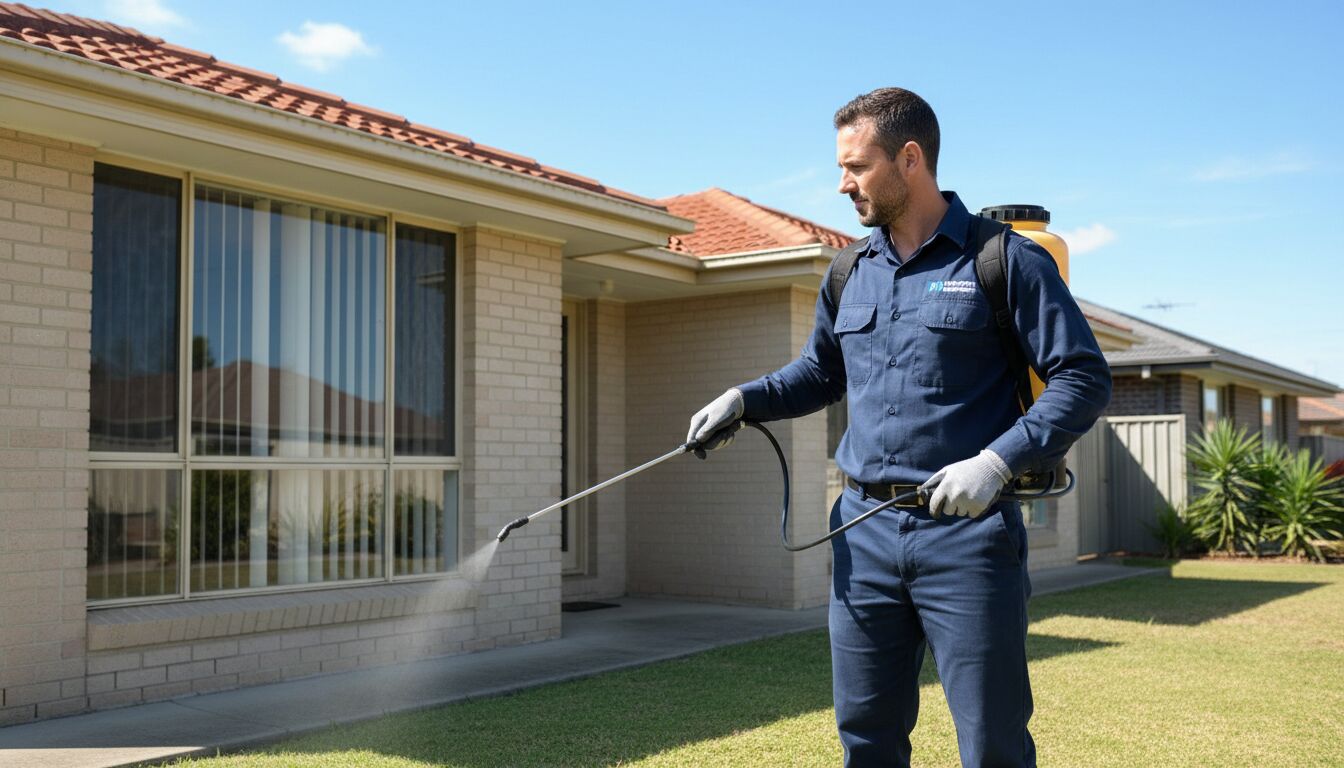
We treat the spider, not just the web. Residual treatment to harbourages and entry points, Redback hotspot targeting, and insect reduction to remove their food source.
Inspection & risk assessment
We inspect the exterior, interior, roof void and subfloor to identify spider species, locate webs and harbourages, and assess risk — particularly Redback hotspots around children's play areas and outdoor furniture.
Targeted web & harbourage treatment
We treat webs, egg sacs and harbourage areas — under eaves, in sheds, around windows and in dry sheltered spots where Redbacks build. Removing webs and treating the spider (not just the web) is what stops them coming back.
Interior & perimeter treatment
A residual treatment to corners, skirting, window reveals and exterior entry points to prevent wandering spiders from entering. We target the cracks and crevices spiders shelter in.
Insect reduction
Spiders go where their food goes. By reducing the insect population around your home — flies, mosquitoes, moths — we remove the food source that attracts spiders in the first place. This is included in every treatment.
How to stop spiders coming back.
Spiders follow their food. Reduce the insects and clear the harbourages and most spider problems resolve themselves — after we’ve done the treatment.
- Clear clutter from sheds, garages and outdoor storage — Redbacks love dry undisturbed areas
- Wear gloves when reaching into letterboxes, pot plants or stored items
- Keep outdoor furniture, play equipment and BBQs free of webs
- Trim vegetation away from the exterior walls of the house
- Reduce exterior lighting or use yellow globes to attract fewer insects at night
- Seal gaps around windows, doors and vents where spiders enter
- Check shoes and bedding before use, particularly in warmer months
- Keep firewood stacked away from the house and check before bringing inside
Webs in the same spots every morning? Send us a photo or tell us what you’re seeing and where — we’ll identify the species and explain what a treatment involves.
Call 07 3206 6721Book a treatmentIdentify my pestSpider control FAQs
How do I get rid of spiders in Brisbane?
Pest-Nett gets rid of spiders by treating webs and harbourages, applying residual treatment to entry points and corners, and reducing the insect population that spiders feed on. We focus on Redback hotspots — letterboxes, sheds, outdoor furniture and play areas — and include a perimeter treatment that stops wandering spiders from entering. Most spider problems are resolved in one visit; we recommend an annual general pest treatment that includes spiders.
How do I get rid of Redback spiders?
Pest-Nett gets rid of Redbacks by locating every web and harbourage in dry, sheltered spots around your home — under eaves, in letterboxes, around pot plants, in sheds, under outdoor furniture and play equipment — and treating them directly. Redbacks are not eliminated by generic surface sprays because they hide in crevices. Our treatment targets the spider, not just the web, and the residual barrier stops new Redbacks from establishing. If you have children, tell us so we can prioritise play areas.
Are Redback spiders dangerous?
Yes. Redback bites cause intense pain, sweating, nausea and muscle weakness. Bites are a medical event — particularly for children, the elderly and pregnant women. If bitten, keep the person still, apply a cold compress and call 000 or go to the nearest emergency department. Do not use pressure bandaging — that increases pain. Redback antivenom is available and effective.
Should I kill huntsman spiders?
Generally not. Huntsman spiders are large and alarming but not aggressive — they rarely bite, and their venom is low-risk to humans. They hunt other insects at night and are beneficial around homes. If one is inside and you want it gone, the best approach is to trap it under a container and slide a sheet of paper under to carry it outside. Pest-Nett's spider treatment will reduce huntsman sightings by removing harbourages and entry points, but we do not target beneficial spiders unnecessarily.
Why do I get spiders after rain?
Rain drives insects indoors and to the exterior of homes — and spiders follow their food. Warm, wet weather in Brisbane also triggers spider breeding activity. After rain, it is common to see more spiders both indoors and around exterior lights. A perimeter treatment applied before the wet season prevents this.
How long does spider treatment last?
A professional spider treatment is effective for months, depending on weather exposure and the surrounding environment. We include it in an annual general pest treatment for most homes. Properties near bushland, water or with heavy insect activity benefit from a six-monthly treatment.
Get rid of spiders — properly.
Target the spider, barrier the perimeter, reduce the food. One Brisbane team, one treatment. Mon–Fri, 8:00–17:00.