Mosquito control.
Remove the breeding sites, barrier the backyard.
Mosquitoes carry Ross River virus and ruin Brisbane outdoor living. Pest-Nett finds every breeding site, treats the resting areas, and barriers your perimeter — so you can use your patio at dusk again.
Can’t use the patio at dusk? A single pot saucer with standing water can produce dozens of mosquitoes per week. We find and eliminate every breeding site on your property — then barrier the areas you want to use.
Call 07 3206 6721Mosquitoes in Brisbane.
Brisbane has more than 30 mosquito species. The ones that matter for homeowners breed in standing water around the house and rest in vegetation during the day. They are most active at dawn and dusk from September to April.
Why they come back so fast.
- Eggs hatch in water within 24–48 hours
- Full cycle in 7–10 days in warm weather
- One female lays 100–300 eggs at a time
- 1cm of water is enough to breed mosquitoes
Breeding sites on your property.
The key to mosquito control is removing the water they breed in. Every standing water source is a potential nursery — here are the most common in Brisbane backyards.
Pot plant saucers
The most common breeding site in Brisbane gardens. A saucer with 1cm of water can produce dozens of mosquitoes per week.
Blocked gutters
Leaves and debris trap water in gutters, creating a perfect mosquito nursery above the house.
Buckets & containers
Any open container that holds water for a week — wheelbarrows, buckets, tarpaulins, children's toys — breeds mosquitoes.
Ponds & water features
Still water without fish or circulation is an ideal breeding ground. A single neglected pond can supply an entire street.
Drains & soakwells
Slow-draining drains and stormwater soakwells hold water long enough for mosquitoes to complete their breeding cycle.
Rainwater tanks
Poorly screened tanks allow mosquitoes in. A screened tank is fine; an unsealed one is a massive breeding site.
Why mosquitoes are a health risk in Brisbane.
Mosquitoes are not just a nuisance. In Brisbane they carry viruses that cause weeks or months of illness.
Ross River virus
The most common mosquito-borne disease in Queensland. Symptoms include joint pain, fatigue, rash and fever that can last weeks or months. There is no vaccine — prevention is the only protection.
Barmah Forest virus
Similar to Ross River virus, with joint pain, fatigue and rash. Also transmitted by Brisbane mosquitoes. No vaccine available.
Dengue & Zika risk
Not currently locally transmitted in Brisbane, but the Aedes mosquito vectors are present in Queensland. International travel cases make mosquito control a public health priority.
Nuisance & outdoor impact
Beyond disease, mosquitoes ruin outdoor living. BBQs, patios and backyards become unusable at dusk in warm months — which in Brisbane is most of the year.
Signs of a mosquito problem.
If you can’t sit outside at dusk without being bitten, you have a mosquito problem. Here is what to check for.
- Mosquitoes swarming in the evening, particularly at dawn and dusk
- Mosquito bites appearing overnight, especially on children
- Buzzing around outdoor areas, patios and BBQs at dusk
- Standing water collecting in pot plant saucers, gutters, tarpaulins and drains
- Wrigglers (larvae) visible in still water — buckets, birdbaths, ponds
- Dense vegetation or overgrown garden where mosquitoes rest during the day
- High insect activity near creeks, drains or low-lying areas
Professional mosquito treatment.
We don’t just fog the air. We find and eliminate breeding sites, treat the vegetation where mosquitoes rest, and barrier your outdoor living areas so you can use them again.
Property inspection
We walk your property to find every breeding site — pot saucers, blocked gutters, standing water, overgrown vegetation and entry points. Identifying and removing breeding sites is the single most effective mosquito control step.
Breeding site elimination
We clear or treat standing water and advise on permanent fixes — gutter cleaning, tank screening, drainage and water feature management. No breeding sites means no new mosquitoes.
Resting site treatment
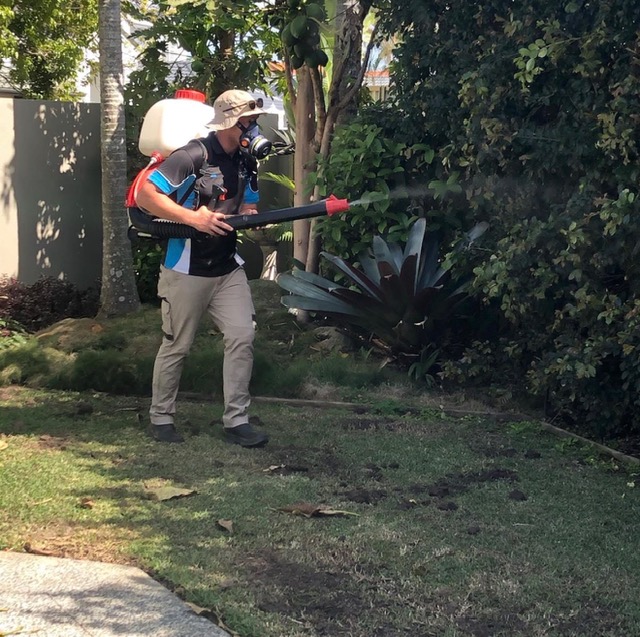
Mosquitoes rest in dense vegetation during the day. We treat foliage, hedges and shaded vegetation around the perimeter of the house with a residual treatment that kills mosquitoes on contact — reducing the population that's already on your property.
Perimeter barrier
A residual barrier around windows, doors, eaves and outdoor living areas that kills mosquitoes as they enter — giving you usable outdoor space at dusk during the Brisbane mosquito season.
How to stop mosquitoes coming back.
No standing water means no breeding. Here’s what keeps a treated yard clear.
- Empty pot plant saucers weekly or fill with sand to prevent standing water
- Clean gutters regularly — leaves trap water and breed mosquitoes
- Screen rainwater tanks and water features with fine mesh
- Store buckets, wheelbarrows and containers upside down or under cover
- Trim dense vegetation where mosquitoes rest during the day
- Use outdoor fans on patios — mosquitoes are weak fliers
- Install flyscreens on windows and doors
- Avoid outdoor activity at dawn and dusk during peak season
Eaten alive at dusk? Tell us what you’re seeing and where — we’ll find the breeding sites and barrier your outdoor areas.
Call 07 3206 6721Book a treatmentIdentify my pestMosquito control FAQs
How do I get rid of mosquitoes in my Brisbane backyard?
Pest-Nett gets rid of mosquitoes by inspecting the property for breeding sites, treating resting sites in vegetation with a residual treatment, and laying a perimeter barrier around outdoor living areas. The most effective step is eliminating standing water where mosquitoes breed — pot saucers, blocked gutters, buckets and ponds. We find and treat every breeding site, then barrier your outdoor areas so you can use your patio at dusk again.
What diseases do mosquitoes carry in Brisbane?
Brisbane mosquitoes carry Ross River virus and Barmah Forest virus — both causing joint pain, fatigue, rash and fever that can last weeks or months. There is no vaccine for either. Dengue and Zika are not currently locally transmitted in Brisbane, but the mosquito vectors are present in Queensland, which is why mosquito control is a public health priority. Reducing breeding sites and treating resting areas is the best protection.
How do mosquitoes breed so fast?
Mosquitoes lay eggs on or near water. The eggs hatch into wrigglers (larvae) within 24–48 hours, then become pupae, then adults — the full cycle can complete in as little as 7–10 days in warm Brisbane weather. A single female can lay 100–300 eggs at a time. A pot saucer with 1cm of water can produce dozens of mosquitoes per week — which is why removing breeding sites is more effective than spraying adults.
When is mosquito season in Brisbane?
Mosquitoes are active most of the year in Brisbane, but peak season is September to April — the warm, wet months. Populations surge after rain and during high tides in coastal areas. The best time for a professional treatment is early in the season (September–October) before populations peak, but we treat throughout the year.
Are mosquito treatments safe for pets and children?
Yes. Pest-Nett uses pet and child friendly products as standard. We apply residual treatment to vegetation and perimeter surfaces — not to living areas or open water. We advise keeping people and pets off treated surfaces until dry (usually 1–2 hours). We will also advise on removing breeding sites that are accessible to children.
How long does mosquito treatment last?
A professional mosquito treatment is effective for 4–6 weeks, depending on weather and the surrounding environment. Properties near creeks, drains or bushland may need monthly treatment during peak season. We recommend a treatment at the start of the season and repeat treatments as needed — we will advise on frequency after the inspection.
Get your backyard back.
Find the breeding sites, treat the resting areas, barrier the perimeter. One Brisbane team, one treatment. Mon–Fri, 8:00–17:00.