German cockroach control.
The cockroach that breeds faster than you can spray.
German cockroaches are the most common and difficult cockroach pest in Brisbane homes and food businesses. Pest-Nett locates the harbourage, baits the colony, and follows up with monitoring until the population is gone — not just the ones you can see.
Seeing them during the day? A heavy German cockroach infestation has run out of hiding places — daytime sightings mean the population is large. The sooner a professional treats it, the faster it resolves.
Call 07 3206 6721What are German cockroaches?
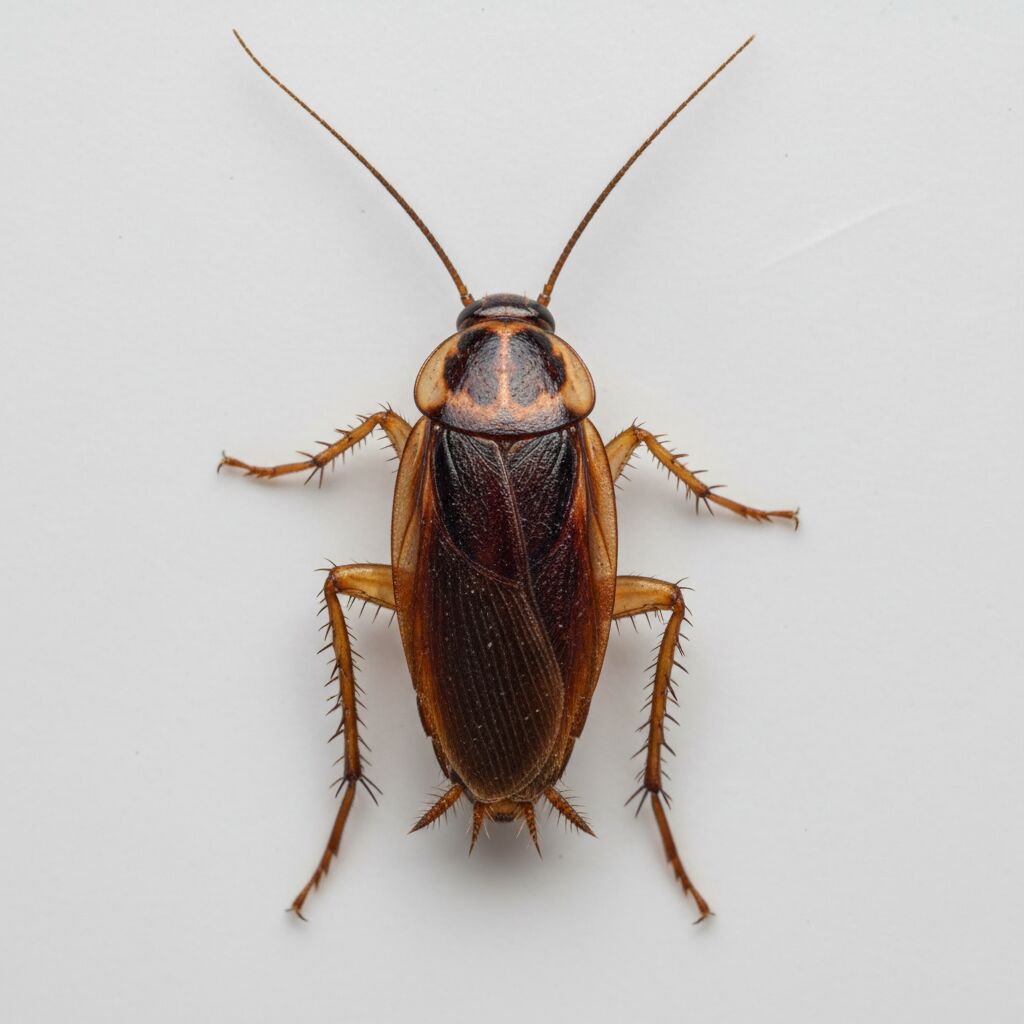
German cockroaches (Blattella germanica) are a small, light brown cockroach with two dark parallel stripes running down the back of the head. Adults grow to 13–16mm; nymphs are smaller, darker and wingless. Unlike the large native cockroaches that wander in from outside, German cockroaches live and breed indoors — in kitchens, bathrooms, appliances, cupboards and voids.
They are the most widespread cockroach pest in the world for a reason: they breed fast, hide in tiny cracks, and survive on very little food. A single female and her offspring can produce hundreds of cockroaches within months. That is what makes them harder to control than any other cockroach in Brisbane.
Not your average cockroach.
The big black cockroaches most Brisbane homes see outside are native species that wander in accidentally — unsettling, but not an infestation. German cockroaches are different. They live indoors, breed indoors, and never leave voluntarily. If you are seeing them in the kitchen at night, you have a population, not a visitor.
- Live and breed entirely indoors
- Hide in cracks as thin as a coin edge
- One female can produce hundreds in months
- Carry bacteria and trigger asthma
Why German cockroaches are a serious problem.
They are not just a nuisance. German cockroaches are a recognised health hazard and a compliance breach in food businesses.
Health
They carry bacteria including Salmonella and E. coli, contaminate food and surfaces, and their droppings, cast skins and saliva trigger asthma and allergic reactions — particularly in children.
Reproduction
A female produces an egg case every 3–4 weeks, each holding 30–40 eggs. Under warm, humid Brisbane conditions a small sighting can become an infestation within weeks.
Compliance
In restaurants, cafés, food production and storage, German cockroaches are a reportable breach of HACCP, food safety and workplace health requirements — not a problem you can leave for later.
Signs of a German cockroach infestation.
German cockroaches are nocturnal — if you are seeing them in the day, the population is already large. Here is what to check for before it gets to that point.
- Live cockroaches in kitchens, bathrooms or near appliances — especially at night
- Droppings that look like ground pepper or coarse black dust in cupboards and drawers
- Egg cases (oothecae) — small brown capsules tucked into cracks and hinges
- A musty, oily odour in cupboards or behind appliances
- Smear marks along corners and edges where cockroaches travel
- Cast skins — translucent shells left behind as nymphs moult
- Cockroaches scattering when you switch on a light at night
How German cockroaches enter your home.
German cockroaches rarely walk in through the front door. They hitchhike — and in unit blocks, they spread between homes through shared structures.
- Inside cardboard boxes, grocery packaging and delivered goods
- Through gaps around pipes, under doors and around skirting
- From neighbouring units in apartments and townhouses
- Inside secondhand appliances, furniture or electronics
- From drains and grease traps in kitchens and bathrooms
Why over-the-counter sprays and bombs don’t work.
Consumer cockroach products kill the cockroaches you can see. They rarely reach the harbourage — the cracks, voids and crevices where the colony lives and breeds. Here is why a sighting treated with a consumer spray usually comes back.
A single female and her offspring can produce hundreds of cockroaches in months
Egg cases are resistant to many surface sprays and can hatch after treatment
Nymphs hide in cracks as thin as a coin edge — out of reach of sprays
Over-the-counter bombs drive them deeper into walls and voids
Resistant strains have developed immunity to common consumer insecticides
Without finding the harbourage, the population rebounds within weeks
Professional German cockroach treatment.
A Pest-Nett treatment does not just spray where you saw a cockroach. We find the harbourage, bait the colony where it feeds, treat the cracks where it hides, and monitor until the population is gone.
Inspection & identification
We locate every harbourage — behind appliances, inside cupboards, around water heaters, under sinks and inside voids — and confirm we are dealing with German cockroaches, not a native species that needs a different approach.
Targeted gel baiting
Professional gel baits placed in cracks, hinges and harbourages where cockroaches actually feed. The active ingredient spreads through the population — including nymphs that never left the harbourage — so we kill the colony, not just the ones you can see.
Harbourage treatment
Residual treatment of cracks, crevices and voids where cockroaches hide and breed. We treat the places they live, not just the surfaces they cross — so the population collapses rather than relocates.
Monitoring & follow-up
Sticky traps and monitoring stations confirm the population is gone. If activity persists, we return — that is what a guarantee means. We do not declare the job done until the traps are clear.
How to stop German cockroaches coming back.
After treatment, the conditions that let them establish need to change. Here’s what keeps a cleared home clear.
- Fix leaking taps and reduce moisture — cockroaches need water to survive
- Store food in sealed containers; never leave food out overnight
- Clean under and behind appliances regularly — grease and crumbs are a food source
- Take out rubbish nightly and keep bins sealed
- Seal cracks around skirting, pipes and cupboards where cockroaches hide
- Check grocery packaging and cardboard boxes before bringing them inside
- Keep drains and grease traps clean and covered
- Don't store cardboard boxes in cupboards or under sinks
Seeing cockroaches day or night? Send us a photo or tell us what you’re seeing and where — we’ll tell you whether it’s German cockroaches and what a treatment involves.
Call 07 3206 6721Book a treatmentIdentify my pestGerman cockroach FAQs
How do I get rid of German cockroaches in Brisbane?
The most effective approach is professional gel baiting combined with residual harbourage treatment — not over-the-counter sprays or bombs, which drive the population deeper without eliminating it. Pest-Nett is a Brisbane-based pest control firm that locates every harbourage, applies professional gel bait where cockroaches actually feed, and follows up with monitoring until the population is gone. We do not declare the job done until the traps are clear.
What do German cockroaches look like?
Adults are 13–16mm long, light brown to tan with two dark parallel stripes running down the back of the head (pronotum). Nymphs are smaller, darker and wingless. Egg cases (oothecae) are light brown capsules about 8mm long. They are smaller than the large native cockroaches most Brisbane homes see outside — the giveaway is the two stripes and the fact they live and breed indoors.
How fast do German cockroaches breed?
A single female can produce an egg case every 3–4 weeks, each containing 30–40 eggs. Under ideal conditions (warmth, moisture, food), a single female and her offspring can generate hundreds of cockroaches within months. That is why a few sightings can become an infestation within weeks — and why early professional treatment matters.
Are German cockroaches dangerous?
They are a significant health risk. German cockroaches carry bacteria including Salmonella and E. coli, trigger asthma and allergies through their droppings, cast skins and saliva, and contaminate food and food preparation surfaces. In commercial food premises they are a reportable compliance breach. In homes they are a health hazard, not just a nuisance.
What causes German cockroaches in a clean house?
German cockroaches do not only live in dirty homes — they enter through grocery packaging, cardboard deliveries, secondhand appliances, from neighbouring units, and through gaps around pipes and doors. Once inside, they need warmth, moisture and a small amount of food (grease, crumbs, even the glue on labels) to establish. A clean home limits those, but a single egg case brought in with a delivery can still start an infestation.
Do German cockroach bombs and sprays work?
They rarely eliminate an infestation. Over-the-counter bombs drive cockroaches deeper into walls and voids, surface sprays kill only the ones that cross the treated surface, and egg cases resist many consumer products. Professional gel baiting works because the bait is carried back into the harbourage and spread through the colony — including nymphs and females that never emerged. That is why a professional treatment resolves an infestation that consumer products cannot.
How long does it take to get rid of German cockroaches?
A typical professional treatment shows a significant reduction within 1–2 weeks as the bait works through the population. We follow up with monitoring to confirm the population is gone. Heavier infestations may require a second visit — we will tell you honestly if that is the case after the inspection.
Do you treat German cockroaches in apartments and unit blocks?
Yes. German cockroaches move between units through shared walls, pipes and voids, so an infestation in one unit often means activity in neighbours. We treat individual units and, for body corporate and strata managers, whole-of-building programs. If you are in a unit block, tell us the unit number and we will also advise on whether neighbours should be checked.
Get rid of German cockroaches — properly.
Find the harbourage, bait the colony, monitor until clear. One Brisbane team, one treatment, and a follow-up if the traps aren’t empty. Mon–Fri, 8:00–17:00.