Ant control.
Kill the colony, not just the trail.
Ants are Brisbane\'s most persistent household pest. Pest-Nett identifies the species, finds every nest, and uses non-repellent treatments the worker ants carry back to the queen — collapsing the colony, not just the line on your benchtop.
Ants in every room? Coastal Brown ants have multiple nests and queens — treating one trail makes no difference. Every nest needs to be found and treated, or the colony bounces back within days.
Call 07 3206 6721Common ants in Brisbane.
Brisbane has dozens of ant species, but a handful cause problems in homes and businesses. The right treatment depends on identifying the right ant — Coastal Brown ants need nest treatment, Black House ants need baiting, and Bull ants need targeted nest destruction.
Know your ant.
- Coastal Brown Ant — lawns, pavers, wall voids
- Black House Ant — kitchens, pantries, roof voids
- Green-head Ant — lawns and gardens, stings
- Bull Ant / Jumper Ant — gardens, powerful sting
- Argentine Ant — supercolonies, mass invasions
The ants Pest-Nett treats.
Each species needs a different approach. We identify the ant before we treat — using the wrong product on the right ant is a waste of time.
Coastal Brown Ant
Pheidole megacephala
Small (2–3mm) light brown ants that nest in lawns, gardens, under pavers and in wall voids. They form dense trails and multiple nests, making them hard to eliminate without treating every colony — not just the trail.
Black House Ant
Ochetellus glaber
Small (2–4mm) shiny black ants that trail indoors foraging for sweet food. They nest in crevices, under paths and in roof voids, and are common in Brisbane kitchens and pantries.
Green-head Ant
Rhytidoponera metallica
Metallic green-bronze ants (5–7mm) found in lawns and gardens. They sting when disturbed — painful but not dangerous. They don't trail indoors but are a problem in outdoor living areas.
Bull Ant / Jumper Ant
Myrmecia spp.
Large (10–25mm) aggressive ants with powerful stings. They nest in soil in gardens and bushland. Their sting can cause allergic reactions — call us if nests are near children's play areas.
Argentine Ant
Linepithema humile
Small (2–3mm) brown ants that form supercolonies with multiple queens. They displace native ants and invade homes in large numbers. Professional perimeter treatment is essential — DIY sprays only scatter them.
Why ants are more than a nuisance.
Ants contaminate food, undermine paving, and some species sting. In businesses, trails of ants are a compliance issue.
Food contamination
Ants forage through kitchens and pantries, contaminating food and food preparation surfaces with bacteria picked up from drains, rubbish and outdoor areas.
Property damage
Coastal brown ants and some species undermine pavers, paths and lawns by excavating soil. In damp conditions, some ants nest in timber and exacerbate moisture damage.
Stings & bites
Bull ants, jumper ants and green-head ants deliver painful stings. In sensitive individuals, bull ant stings can trigger allergic reactions requiring medical attention.
Nuisance & distress
Trails of ants through living areas are distressing for households, embarrassing for businesses, and a constant frustration if the colony is not eliminated.
Signs of an ant problem.
If you see a trail, there is a nest — and probably more than one. Here is what to check for.
- Visible trails of ants along skirting, window sills, benches or between rooms
- Ant nests in lawns, under pavers, in garden beds or near foundations
- Fine soil or sand piles where ants are nesting under stones or pavers
- Ants in the kitchen or pantry, particularly around sweet or greasy food
- Ants in bathrooms, laundries or near water sources
- Sawdust-like debris near timber — a sign of nesting in damp wood
- Small piles of dead insects or debris outside nest entrances
Why over-the-counter sprays don’t work.
Consumer ant sprays kill the ants you can see. They don’t reach the nest or the queen — so the colony sends more. Here is why a trail treated with a consumer spray usually comes back.
Surface sprays kill foraging ants but don't reach the nest or the queen
Killing visible ants makes no difference — the colony sends more
Sugar-based DIY baits attract ants but often don't transfer to the colony
Coastal brown ants have multiple nests and queens — treating one does nothing
Repellent sprays deflect ants into new areas, spreading the problem
Without identifying the species, you may be using the wrong approach entirely
Professional ant treatment.
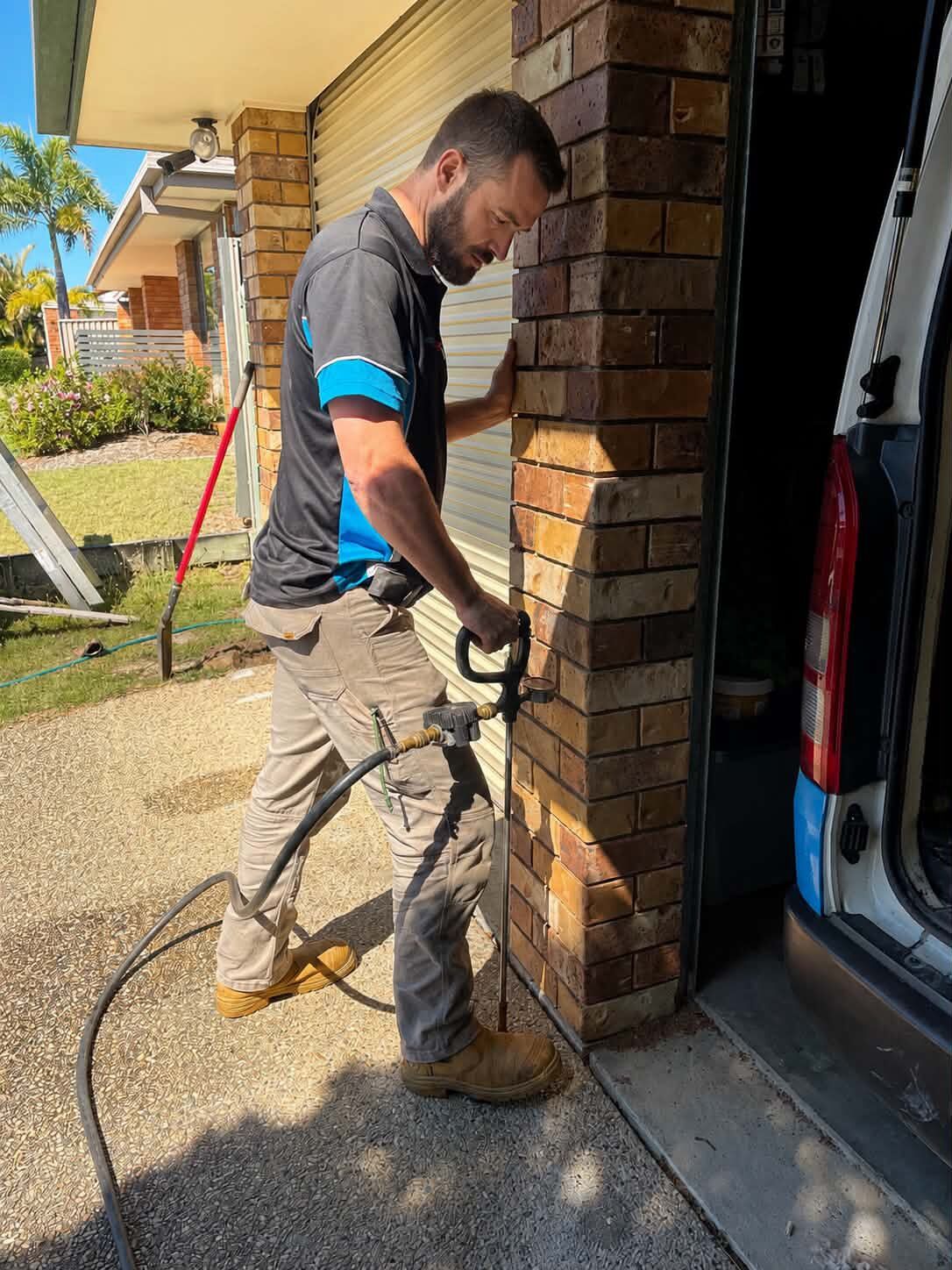
A Pest-Nett treatment starts with identification and ends with the colony gone. We treat every nest, bait the colony from within, and lay a perimeter barrier to stop new colonies moving in.
Inspection & identification
We identify the ant species, find every nest and trace every trail. Different ants need different treatments — Coastal Brown ants need nest treatment, Black House ants need baiting and perimeter barriers, and Bull ants need targeted nest destruction.
Nest & trail treatment
Non-repellent sprays and dusts applied to nests, trails and entry points. Non-repellent products are key — ants walk through the treated zone without detecting it and carry the active ingredient back to the colony.
Targeted baiting
Species-appropriate baits placed where ants actively forage. The workers carry the bait back to the nest and feed it to the queen and larvae, collapsing the colony from within — including nests you can't reach.
Perimeter barrier
A protective treatment around the exterior of your home or building that stops new colonies from moving in. For Coastal Brown ants with multiple nests, we treat every nest — not just the obvious ones.
How to stop ants coming back.
After treatment, the conditions that attracted the colony need to change. Here’s what keeps a cleared home clear.
- Store food in sealed containers; wipe up spills and crumbs immediately
- Don't leave pet food out — feed pets then clean the bowl
- Keep bins sealed and empty rubbish regularly
- Trim branches and plants away from the exterior of the house
- Seal cracks and gaps around windows, doors and skirting
- Fix moisture issues — ants are attracted to damp areas
- Store firewood and building materials away from the house
- Clean outdoor eating areas promptly after use
Trails of ants through the house? Tell us what you’re seeing and where — we’ll identify the species and explain what a treatment involves.
Call 07 3206 6721Book a treatmentIdentify my pestAnt control FAQs
How do I get rid of ants in Brisbane?
Pest-Nett gets rid of ants by identifying the species, treating every nest, and using non-repellent products and baits that the worker ants carry back to the colony — killing the queen and collapsing the nest from within. We don't just spray the trail you can see; we treat the colony you can't. Most ant problems are resolved in one visit, with a perimeter barrier to stop new colonies moving in.
Why do ants keep coming back after I spray?
Because surface sprays only kill the foraging ants — not the nest or the queen. The colony simply sends more workers, often along a new trail. Some sprays are also repellent, meaning ants detect the chemical and route around it, spreading the problem into new rooms. Professional non-repellent treatments work because ants can't detect them and carry the active ingredient back to the nest.
What are the most common ants in Brisbane?
Coastal Brown ants are the most common nuisance ant in Brisbane — they nest in lawns, under pavers and in wall voids, forming dense trails and multiple nests. Black House ants trail indoors for sweet food. Green-head ants and Bull ants are outdoor species that sting. Pest-Nett identifies the species first because the right treatment depends on it — Coastal Brown ants need nest treatment, while foraging ants need baiting and barriers.
Are ant treatments safe for pets and children?
Yes. Pest-Nett uses pet and child friendly products as standard, applied precisely to nests, trails and entry points — not broadcast across living areas. Baits are placed in locations where foraging ants find them but pets and children don't. We give you clear re-entry advice before we leave.
How long does ant treatment last?
A professional ant treatment is effective for months, depending on the species, the property and the surrounding pressure. We recommend an annual general pest treatment that includes ants for most homes; properties with heavy ant pressure (near bushland, or with established Coastal Brown ant nests) benefit from a six-monthly schedule.
Can you treat ants in commercial premises?
Yes. Ants are a common problem in Brisbane offices, restaurants, food storage and strata common areas. We use targeted baits and non-repellent perimeter treatments that don't disrupt your operations, with documentation for food safety and audit compliance. See our Commercial page for more on ongoing management programs.
Get rid of ants — properly.
Identify the species, treat every nest, collapse the colony, barrier the perimeter. One Brisbane team, one treatment. Mon–Fri, 8:00–17:00.